
Protect users before threats reach your network
Enterprise DNS filtering is one of the fastest and simplest ways to stop cyber threats before a connection is established. By inspecting DNS requests and blocking malicious, suspicious, or policy-violating domains at the DNS layer, organizations can reduce exposure to phishing, malware, command-and-control traffic, and unsafe web destinations. That “block early, before the session fully begins” positioning is consistent with how major DNS security vendors and educational resources describe DNS filtering today.
For enterprises managing branch offices, roaming users, hybrid workforces, cloud applications, and BYOD devices, DNSCircle provides a lightweight security layer that is easier to deploy than many traditional controls while still improving visibility and policy enforcement. Competitor pages targeting enterprise buyers emphasize similar themes: broad device coverage, fast rollout, reduced operational burden, and centralized control.
CTA: Request a Demo
What is enterprise DNS filtering?
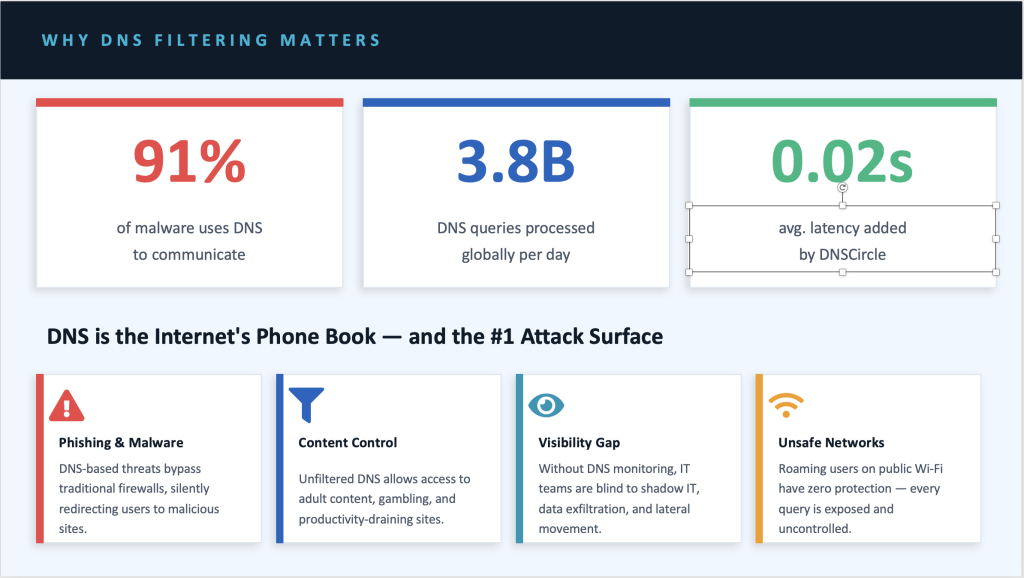
Enterprise DNS filtering is a DNS-layer security control that checks outbound DNS queries against threat intelligence, filtering policies, category controls, and allow/block rules. If a requested domain is known to be malicious, risky, or disallowed by company policy, the request is blocked before the user connects. Cloudflare describes DNS filtering as using DNS to block malicious websites and harmful content, while enterprise vendors frame it as protective DNS for distributed organizations.
This matters because nearly every internet session starts with DNS. Blocking unsafe destinations at this stage can prevent users and devices from reaching phishing sites, malware payload hosts, and botnet infrastructure before deeper inspection tools even come into play. Fortinet and DNSFilter both highlight malicious domain blocking and command-and-control protection as core outcomes of DNS-layer enforcement.
Why enterprises need DNS filtering
1. Stop phishing and malware earlier
DNS filtering helps block access to malicious domains before a full web session begins. Educational and vendor sources consistently position DNS filtering as an early-stage control against phishing, malware, and unsafe domains.
2. Protect hybrid and remote users
Enterprise networks no longer live inside one office. Ranking vendors strongly emphasize protection for roaming users, hybrid workplaces, and off-network devices because policy enforcement must follow users wherever they connect.
3. Enforce acceptable-use policies
DNS filtering allows security teams to restrict categories such as malware, phishing, adult content, gambling, anonymizers, or any business-specific risk areas. Category-based blocking and policy control are standard features promoted across commercial DNS filtering platforms.
4. Reduce security overhead
Enterprise buyers are often looking for a control that is lighter to deploy and manage than more complex gateway stacks. DNSFilter’s enterprise messaging explicitly ties its offering to reduced ownership and operational costs.
5. Improve visibility across the organization
Modern DNS security platforms increasingly emphasize reporting, insights, behavior visibility, and centralized policy management as important enterprise benefits.
How enterprise DNS filtering works
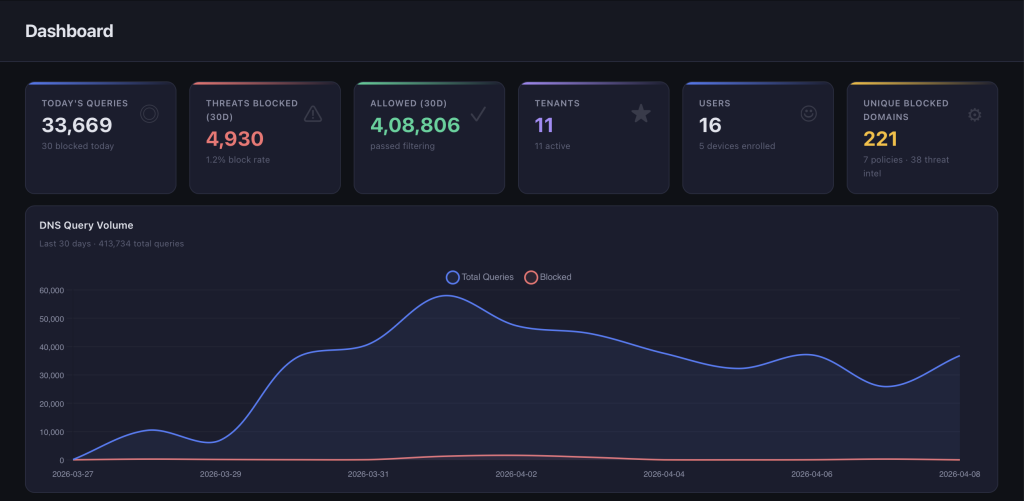
- A user or device requests a domain.
- The DNS query is checked against threat intelligence, policy rules, and content categories.
- Safe requests are resolved normally.
- Malicious, risky, or non-compliant domains are blocked before access is established.
This basic model aligns with public explanations from Cloudflare and multiple commercial vendors.
With DNSCircle, enterprises can apply centralized DNS security policies across offices, remote endpoints, and distributed teams without forcing every protection decision through heavier traffic inspection layers.
Key capabilities businesses should look for
A strong enterprise DNS filtering solution should include:
- Real-time malicious domain blocking
- Protection against phishing and malware
- Command-and-control domain blocking
- Category-based filtering and custom policies
- Centralized reporting and visibility
- Support for branch offices and roaming users
- Easy deployment with low operational overhead
- Integration with broader security workflows
These are recurring themes across current market pages and buyer-focused comparison content for enterprise DNS filtering.
Enterprise DNS filtering vs traditional web filtering
DNS filtering and web filtering are related, but they are not the same thing. IBM explains that DNS filtering acts earlier and more preventively, while web filtering often provides deeper inspection later in the session. For many enterprises, DNS filtering becomes the efficient first control, while other tools provide additional inspection where needed.
That makes DNS filtering especially useful for:
- fast protection at scale,
- distributed workforces,
- simpler rollouts,
- reducing exposure before users reach dangerous destinations.
Use cases for enterprise DNS filtering
Hybrid workforce security
Apply consistent policies to users whether they are in the office, working remotely, or moving between locations. Roaming protection is a major theme on currently ranking vendor pages.
Branch office protection
Standardize DNS-layer controls across multiple sites without deploying complex infrastructure everywhere.
BYOD and contractor access control
Protect unmanaged or lightly managed devices by enforcing safe DNS resolution and blocking known-risk destinations.
Malware and botnet prevention
Prevent infected endpoints from reaching malicious domains, callback servers, or command-and-control infrastructure. Fortinet explicitly highlights botnet C&C blocking in its DNS security messaging.
Policy enforcement and safer browsing
Control access to categories that create compliance, productivity, or security concerns.
Why choose DNSCircle for enterprise DNS filtering
DNSCircle helps enterprises secure users at the DNS layer with a model designed for modern, distributed environments. Instead of waiting for threats to fully load or relying only on heavier perimeter controls, DNSCircle enables organizations to stop risky destinations early, apply centralized policies, and extend protection to remote users and branch offices.
Benefits of DNSCircle
- Block malicious and policy-violating domains early
- Extend protection to hybrid and roaming users
- Enforce category-based access controls
- Improve visibility into DNS activity
- Deploy faster with lower operational friction
- Strengthen enterprise security without unnecessary complexity
CTA: Request a Demo
Frequently asked questions
What is enterprise DNS filtering?
Enterprise DNS filtering is a security approach that blocks malicious, suspicious, or policy-violating domains at the DNS lookup stage, before a user fully connects to a destination.
How does DNS filtering help businesses?
It helps businesses block phishing, malware, unsafe domains, and non-compliant content while improving centralized control and visibility across users, devices, and locations.
Is DNS filtering useful for remote employees?
Yes. Current enterprise vendors strongly market DNS filtering for roaming devices, hybrid workforces, and off-network protection.
What is the difference between DNS filtering and web filtering?
DNS filtering acts earlier in the connection process, while web filtering generally provides deeper inspection later. Both can work together, but DNS filtering is often the lighter and faster first layer.
Can enterprise DNS filtering stop command-and-control traffic?
It can help block access to known malicious domains and botnet command-and-control infrastructure at the DNS layer, which is a core value proposition highlighted by enterprise DNS security vendors.